
Command & Coordination: Where ICS Shifts Between the Frontline and the Coordination Centre
- Marc
- Oct 13, 2025
- 6 min read
Let's begin with explaining the Incident Command System (ICS), its history and why we are using it to deal with the various emergencies and disasters.
What is ICS?
The Incident Command System (ICS) is a standardized on-site all-hazards command & control system designed to enable effective, efficient incident management by integrating a combination of facilities, equipment, personnel, procedures, and communications operating within a common organizational structure from multiple organizations.

History of ICS
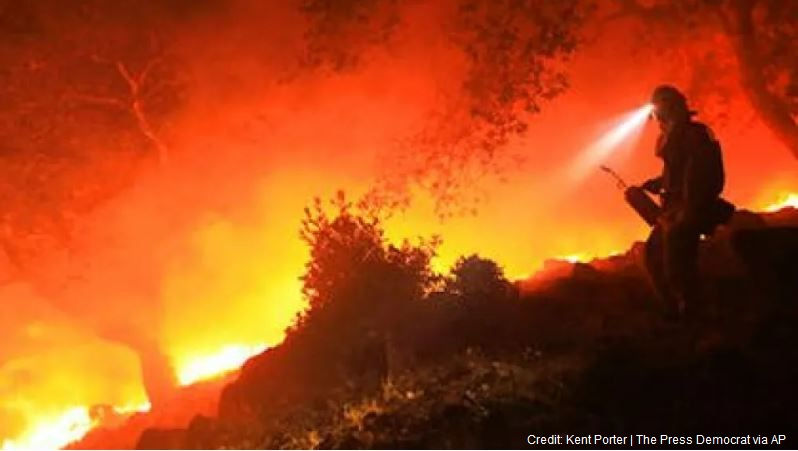
The origins of the Incident Command System comes from the 1970 southern California interface wildfires that, in 13 days, burned over 1/2 million hectares, destroyed nearly 800 buildings, killed 16 people and cost over $233 million. The U.S. Forest Service, with their partner response agencies in Southern California, examined the incident management efforts and it revealed several issues, most notable:
At the incident or field level, there was confusion derived from different terminology, organizational structure, and operating procedures between the various response agencies.
Above the incident or field level at the agency or coordination level, the mechanisms to coordinate and handle competing resource demands and to establish consistent resource priorities was inadequate.
After this review FIRESCOPE (Firefighting Resources of Southern California Organized for Potential Emergencies) was established.
It should be noted that the system was not always called ICS; it was originally called Field Command Operations System. The original design intent was to “field a system which would provide uniform terminology, procedures, and incident organization structure required to ensure effective coordinated action when two or more agencies are involved in a combined effort”.
Since then and after many other multi-agency incidents, ICS has been widely adopted by both industry and government in the United States. Following the Exxon Valdez oil spill in 1989, the Alyeska Pipeline Service Company adopted ICS.
After the September 11th, 2001 World Trade Center attacks the President of the United directed the development of a single, national incident management system. After careful review of existing command and control and incident management systems, ICS and MACS (Multi-Agency Coordination Centers) became cornerstones of the National Incident Management System (NIMS) in 2004. (Credit: FIRESCOPE).
The Government of British Columbia was the first province to adopt ICS as a standard for site management of a large incident within the Incident Command Post in 1992 and is a foundation of the British Columbia Emergency Response Management System (BCERMS).
In 2002, the Canadian Interagency Forest Fire Centre (CIFFC) adopted ICS as part of their mandate to its federal, provincial and territorial members, The agency developed a complete set of training materials specifically aimed at the wildland fire community. However, a number of non-wildland fire organizations adopted ICS for their organizations shortly afterwards. What began as a plan for wildfires soon became a system for all kinds of emergencies. Over the years, more and more organizations adopted this system, making it widely accepted across Canada.
In 2009, the CIFFC sponsored through Parks Canada and working with various agencies such as the Alberta Emergency Management Agency, provided a completely revised training regime for all Ground Search and Rescue (GSAR) within Canada. This was the start of the establishment of ICS Canada, which now sets the standards and is the doctrine for ICS in Canada. (Credit: ICS Canada)
Why use ICS
The Incident Command System can be used equally well for both small and large incidents. ICS is used to manage on-scene, tactical-level response. There are a number of benefits to use ICS at the site of an incident, but in short:
Common Terminology amongst the responding agencies
Structured approach to incidents, i.e. everyone uses the same protocols
Flexibility, i.e. if small incidents get larger it is easy to get additional resources to cope with the situation. If incidents get under control it is easy to reduce the resources.
Increased safety for the responders.
ICS is based on 14 Principles and Features that will facilitate the response to any incident. Those principles and features are:

Common terminology
Establishment and transfer of command
Chain of command and unity of command
Unified command
Management by objectives
Incident Action Plan (IAP)
Modular organization
Manageable span of control
Comprehensive resource management
Incident locations and facilities
Integrated communications
Information and intelligence management
Accountability
Dispatch/Deployment
So we've explained the reasons for the application of ICS at the site of an incident. Now let's discuss the need for the application of ICS at an Emergency Operations Centre and if there is a need for this at all.
Before we go into the use of ICS at an EOC/ECC, let's go over some ICS terms relevant to this discussion.
Incident command post
The incident command post (ICP) is located at or in the immediate vicinity of the incident site and is the focus of the conducting of direct, on-scene control of tactical operations. Incident planning is also conducted at the ICP.
The ICP may be collocated with the incident base camp. This is the location (ICP) where the incident commander (IC) and their incident management team such as command and general staff, is located and from where they direct ALL tactical operations and incident management, whether it is from a first response vehicle or in a full incident command post located in a building or an ICP within a base camp.
Incident management team
An incident management team is a group of highly skilled and trained personnel that work as a cohesive unit during the phase of an incident, often in support of a specific community or region and with a specific delegation of authority. An Incident Management Team may also be stood up in an EOC/ECC.
ICS at an EOC or ECC
Let's start with the definitions of an EOC and ECC.
EOC:
An Emergency Operations Centre (EOC) is a place removed from the incident and consists of several components:
Personnel – who fulfill functions which strengthen an organization’s managerial and organizational capacity during large scale events, such as emergencies, disaster relief and humanitarian aid operations. First of all, an EOC can be considered a management resource that can be used to strengthen an organization’s regular management and organizational capacity during times of emergency or disaster.
Location – the physical site and material where designated personnel gather to collectively and collaboratively support the Incident Command (IC) and/or Unified Command (UC) and manage secondary and tertiary consequences of an incident or event. and this centre fulfils a coordination function and NOT a command function.
Within the EOC various agency representatives could be found where they discuss:
priorities,
resources,
public information,
agency policy
provide coordination and guidance functions to the incident commander (IC) and his/her team at the ICP.
ECC:
Emergency Coordination Centre (ECC) means the physical location at which the coordination of information and resources to support incident management (on scene operations) activities normally take place. An ECC may be a temporary facility, perhaps a higher level of organization within a jurisdiction. ECC’s may be organized by major functional disciplines (e.g., fire, law enforcement and medical services), by jurisdiction or by a combination of all of those.
It is important to understand that the critical roles for either the EOC or ECC is:
Support the Incident Commander at the Incident Command Post
Coordinate resources
Develop and provide situational awareness
Support communities and other jurisdictions
Keeping the media informed
The province of BC uses ICS at their EOC's as do many other agencies or government agencies. Certainly larger organizations such as provinces may not necessarily have Incident Command Posts in place for incidents, as they may be coordinating the response rather than actively Command an incident. But they may have agency Representatives at ICP's set up by municipalities or federal agencies. So the use of ICS is completely justified.
However, the use of ICS at an EOC or ECC is NOT required. It is up to the lead agency to set the parameters of the response. Many jurisdictions—including BC—choose to apply ICS principles for consistency and coordination.
When we clearly define the lines from an ICP (at Site) to an EOC/ECC and use proper Common Terminology at the right places, during incidents, whether small, large or even complex incidents we can make a difference.


Comments